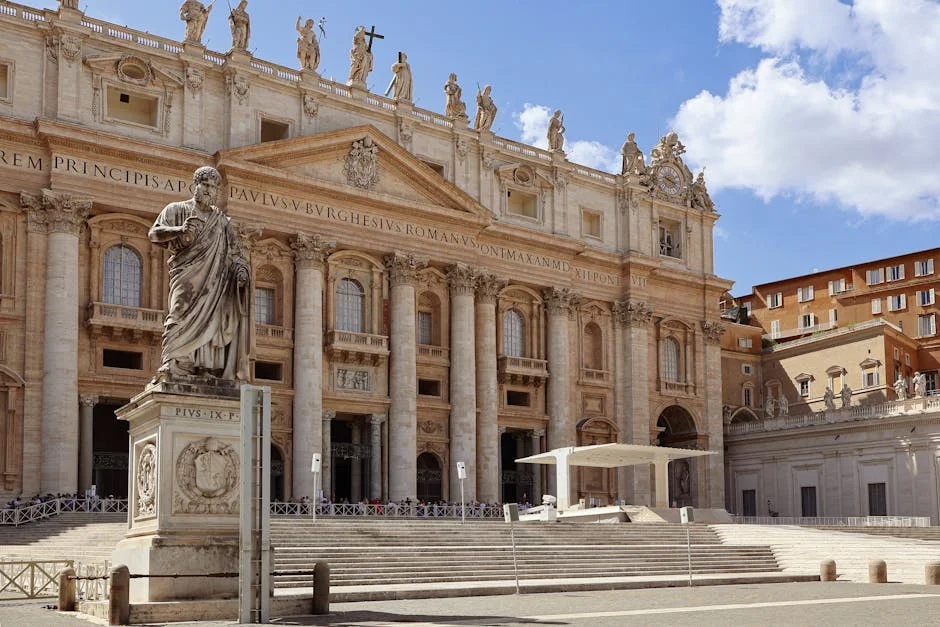
Pope Leo has pledged to continue condemning war following recent remarks by former US President Donald Trump, who called for military action against Iran. The Vatican's stance comes amid rising global tensions and has sparked discussions in India, where citizens are closely watching geopolitical shifts that could influence regional stability and foreign policy. The Pope's statement, made during a public audience in Vatican City, highlights concerns over the escalation of conflict and its global repercussions.
Pope's Strong Message Against War
The Pope's remarks, delivered on 15 May, were a direct response to Trump’s comments, which he called “dangerous and reckless.” In a rare public condemnation of a sitting or former world leader, the Pope urged nations to prioritize diplomacy over aggression. “War is not the solution,” he said, “it only brings suffering to the innocent.” The statement was broadcast live to millions across the world, including in India, where religious and political leaders are closely following the Vatican’s stance on global conflicts.
India, with its large Muslim population and strategic ties to both the West and the Middle East, is particularly sensitive to shifts in religious and political rhetoric. The Indian government has not yet commented on the Pope’s remarks, but analysts say the statement could influence public opinion and diplomatic relations. “The Pope’s voice carries weight, especially in a country like India, where religion and politics often intersect,” said Dr. Priya Mehta, a political analyst at Jawaharlal Nehru University.
Trump's War Rhetoric and Global Reactions
Trump’s comments, made during a rally in Florida in March, were widely criticized by international leaders and human rights organizations. “I would bomb the hell out of Iran,” he said, a statement that drew sharp rebukes from the United Nations and the European Union. The Pope’s response is seen as a counterbalance to such rhetoric, reinforcing the Vatican’s long-standing position on non-violence and peace.
The Indian media has closely covered the Pope’s statement, with several newspapers running front-page stories. “The Pope’s message is a reminder that even in times of crisis, we must not abandon dialogue,” wrote The Hindu in a recent editorial. The article also highlighted the growing concerns among Indian citizens about the potential for regional conflicts to spill over into South Asia.
The Pope’s stance has also resonated with religious communities in India, particularly in states like Kerala and Tamil Nadu, where Catholic populations are significant. “We are grateful for the Pope’s courage in speaking out,” said Father Thomas, a parish priest in Kochi. “His words remind us that peace is a shared responsibility.”
Impact on Indian Public Opinion
Public reactions in India have been mixed. While many citizens appreciate the Pope’s call for peace, others argue that the Vatican should focus more on internal issues rather than global politics. “The Pope is a spiritual leader, not a political one,” said Ravi Sharma, a Delhi-based social media influencer. “His comments may be well-intentioned, but they don’t address the real problems facing India.”
Despite this, the Pope’s statement has sparked broader conversations about the role of religion in global affairs. In a country where religion plays a central role in public life, the Pope’s words have been interpreted as a call for unity and moral clarity. “This is not just about war,” said Dr. Mehta. “It’s about how faith can shape public discourse and influence policy.”
What to Watch Next
Indian diplomats and religious leaders are expected to monitor further developments, particularly as tensions between the US and Iran continue to rise. The Pope’s statement may also influence future interfaith dialogues in the region, with several Indian organizations planning to host events in the coming months. “We are looking to build on this momentum,” said Anjali Desai, a representative from the Indian Council of Religious Understanding.
As the world watches how the US and Iran navigate their differences, the Pope’s message serves as a reminder of the importance of peaceful resolution. For Indian citizens, the situation is a reminder of how global events can shape local realities, from foreign policy to religious harmony. The coming weeks will be crucial in determining how this dialogue evolves and what it means for the region.